Mana Pools
Along 219 km of the Zambezi, Mana Pools is Zimbabwe's park where you approach elephants on foot, beneath albida acacias, in light sought after by photographers.
Mana Pools occupies the southern bank of the Zambezi, spanning 219 kilometres of border with Zambia, in the Lower Zambezi valley. The name comes from the Shona mana, meaning four, referring to the four dead arms of the river that form permanent pools at the heart of the park: Main, Chine, Long and Chisambuk. These water bodies retain both light and dense wildlife throughout the dry season, when the interior dries out. The park, inscribed on the UNESCO World Heritage list since 1984 alongside the adjacent safari zones of Sapi and Chewore, covers 2,196 km² between the Rift Valley escarpment to the south and the river to the north.
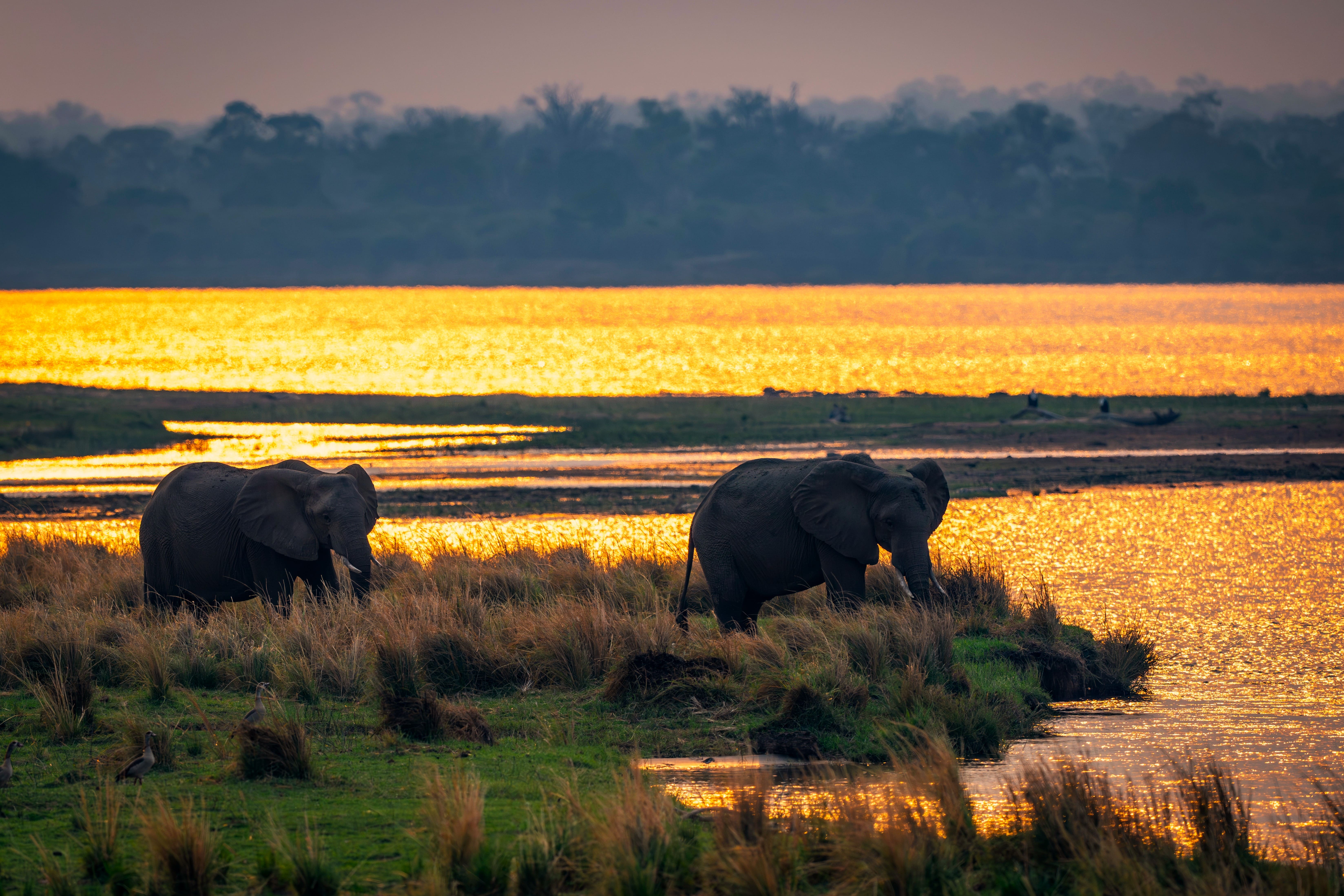
What strikes you upon arrival is the landscape's structure. The alluvial plain is dominated by very old albida acacias (the winterthorns), sycamore figs and sausage trees, spaced out across parkland savanna. This vegetation architecture, without dense undergrowth, creates long-distance visibility and explains why Mana is the preferred playground of wildlife photographers: the raking light of early morning and late afternoon cuts through the trunks, bathing the plain in a golden glow that few other parks in southern Africa offer.
Mana Pools is one of the rare parks on the continent where walking approach to large mammals is legal, conducted by professional guides holding the Zimbabwean Professional Guide Licence—one of Africa's most demanding certifications (five years of training, final field exam). You walk to approach herds of elephants, some known locally by name (Boswell, famous for rearing up on his hind legs to reach apple-ring acacia pods, was long the park's emblem). You also encounter hippopotamuses out of water, buffalo, wild dogs (Mana harbours one of southern Africa's last stable populations, studied since the 1990s) and the rare nyala antelope, present mainly in riverine thickets.
The river itself structures the park experience. You can paddle it over several days, in guided convoys, between Chirundu and Kanyemba, camping on islands or sandbars. It's another way to see Mana: at hippopotamus height, without engine noise, with crocodiles basking on the banks and colonies of carmine bee-eaters nesting in clay banks from August to November. Anglers come for the tigerfish, the Zambezi's apex predator, and casting from the banks near Nyamepi.
The park has no resident population. The nearest villages—Marongora atop the escarpment and Chirundu at the border post with Zambia—live from cross-border trade, artisanal fishing and safari tourism. The track descending the escarpment from Marongora to the plain, roughly 70 kilometres of laterite, is itself part of the journey: in two hours you transition from the cool, closed miombo woodland to the open Zambezi plain, several degrees warmer.
Mana remains a lightly developed park: no lodge infrastructure on the scale of Hwange, just a handful of semi-permanent camps (Nyamepi for public camping, Mucheni, Ndungu, and a few private camps operated under concession like John's Camp, Kanga or Zambezi Expeditions). This low infrastructure density is a management choice that preserves the site's raw character and shapes logistics: we work exclusively with accredited operators, and our guides know personally the rangers of the Zimbabwe Parks and Wildlife Management Authority based at Nyamepi.
Things to discover
Walking approach to elephants. Observation walks at 30 or 40 metres from herds across the alluvial plain, led by a licensed professional guide. This is Mana's signature experience, possible nowhere else with this quality of proximity.
Canoeing the Zambezi. Three to four days paddling between Chirundu and Mana Main, with camps on islands. You pass banks where elephants come to drink and sleep to the sound of hippopotamuses grazing at night.
The four pools of the plain. Main Pool, Chine Pool, Long Pool and Chisambuk Pool concentrate wildlife in the dry season. Chine Pool, stretching 6 kilometres, is the most frequented meeting point for crocodiles and buffalo herds in late afternoon.
Mana's wild dog packs. A population scientifically tracked since the 1990s by Painted Dog Conservation. The packs hunt at dawn across the open plain, and sighting chances rank among southern Africa's best.
Albida acacia forests backlit. The white trunks and sprawling crowns, photographed early morning with an elephant in silhouette, have become the signature image of the park in contemporary safari photography.
When to go
The park officially closes from late November or early December through late March or mid-April, depending on rainfall. The tracks across the alluvial plain, with their black clay soil, become impassable even for 4x4s, and camps are dismantled or evacuated. The usable season runs from April or May through November. May and June are cool and green, with daytime temperatures around 25 to 28°C and nights dropping to 10°C: vegetation is still dense, wildlife viewing less concentrated, but light is crisp. July and August are dry and cold at night (5 to 8°C before dawn), pleasant during the day.
September, October and early November comprise the most productive window for wildlife: heat climbs to 38 or 42°C in October, water sources inland dry up, and all large mammals converge on the Zambezi and the four pools. This is also the most physically demanding period, suited to travellers who tolerate dry heat. For photography enthusiasts and close-range elephant observation, this is our top recommendation.
Practical advice
We recommend a minimum of three nights on-site, ideally four, to justify the logistical access and alternate vehicle safaris, walks and, if possible, a half-day or overnight canoeing on the Zambezi. Two access options from Harare: a charter flight of approximately 1 hour 15 minutes to the Mana Main airstrip, operated on demand by local operators, or a 4x4 drive of approximately 380 kilometres via Karoi and Marongora—allow 7 to 8 hours from the capital including the escarpment descent at the end. The charter flight is considerably more comfortable but costly; the drive suits experienced self-drive travellers.
Mana logically combines with Hwange (domestic flight via Harare or via Victoria Falls) for landscape contrast: Hwange offers the great herds of the dry Kalahari savanna, Mana the riverine bush and walking approach. The classic 12 to 14-day combination is Victoria Falls, Hwange, Mana Pools, returning to Harare. Camp comfort ranges from simple safari tents (Nyamepi, self-catering) to furnished safari tents with private showers (John's Camp, Kanga). Mana suits travellers who've already done one or two conventional safaris and seek a more raw, active experience with guided walking. It's not a destination we recommend for children under twelve, given walks in unfenced country.