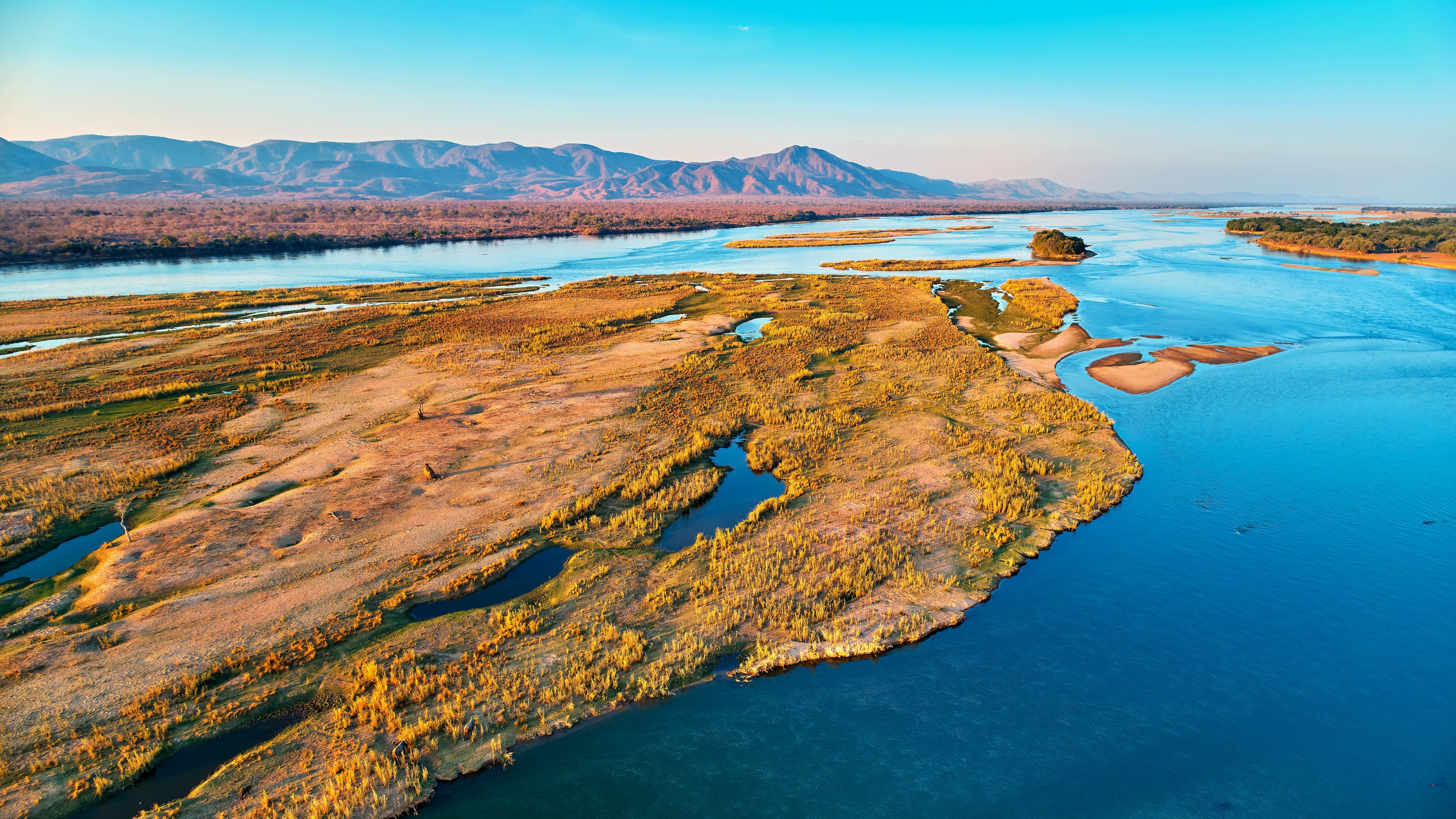
Hwange
14,600 km² of savanna and teak forest at the threshold of the Kalahari, 40,000 elephants concentrated around pumped waterholes, patient observation rather than spectacular landscapes.
Hwange occupies the northwestern corner of Zimbabwe, between the Botswana border and the Bulawayo-Victoria Falls railway line. At 14,600 km², it is the country's largest national park, roughly the size of Belgium. The terrain is flat, sometimes gently rolling with ancient Kalahari dunes, and vegetation alternates between teak forests (Baikiaea plurijuga), mopane savanna and grassy vlei plains. This habitat diversity explains the park's wildlife richness: over 100 mammal species and roughly 400 bird species recorded.
The park is renowned for its elephants. The population fluctuates between 40,000 and 45,000 individuals, one of the highest concentrations in southern Africa. This concentration is entirely artificial: Hwange has no permanent rivers. Without human intervention, most large wildlife would migrate to the Zambezi or Chobe during the dry season. Since the 1930s, roughly sixty waterholes have been pumped artificially, originally by windmills, today by solar panels and diesel generators. The game viewing revolves around these pans—Nyamandhlovu, Kennedy, Guvalala, Shumba—where the bulk of wildlife activity unfolds.
Our English-speaking team organizes stays around three distinct sectors. Main Camp, in the southeast, provides access to the most active pans and concentrates mid-range lodges. Sinamatella, in the north, perches on a basalt escarpment with views over the Lukosi valley, more rugged terrain frequented by reintroduced black rhinos. Robins Camp, in the northwest, reopened in 2020 after renovation and offers the least frequented access, near the Deteema concession. Between these three gateways, private concessions—Linkwasha, Davison's, Little Makalolo and Somalisa—operate as closed lodges with night game drives and walking safaris, options absent from the national park proper.
The territory has been inhabited for centuries. The name Hwange comes from a 19th-century Nhanzwa chief, Hwange Rosumbani. The local population, primarily Nambya and Ndebele, lives around the town of Hwange (formerly Wankie), home to 30,000 people and marked by coal mining that still powers the country's thermal plant. The contrast is stark between the open-pit Hwange Colliery, 20 km from the main park entrance, and the silence of the pans at dawn. This mining economy also explains decent infrastructure: paved road to Main Camp, Hwange airport (HWN) at Dete, and the overnight train stop from Bulawayo to Victoria Falls.
Park management remains a pressing issue. The 2019 drought killed over 200 elephants through dehydration around unpumped waterholes. Local organizations like Friends of Hwange and Painted Dog Conservation, based in Dete, fund part of the pumping and anti-poaching efforts. When you stay in a lodge in the area, a portion of your nightly fee supports these programs. This is a point we systematically clarify when preparing your stay.
Beyond elephants, Hwange harbors one of the last viable populations of African wild dogs in southern Africa, roughly 150 individuals tracked individually by the Dete program. Packs roam territories of 400 to 600 km², making their sighting unpredictable but possible, particularly from June to September when pups emerge from dens. Classic apex predators—lions, leopards, spotted hyenas—are present at healthy densities, with male lion coalitions regularly observed around Ngamo and Kennedy.
Highlights
Hide at Nyamandhlovu Pan. Elevated observation platform 12 km from Main Camp, frequented by elephant herds of 200 to 300 individuals in late afternoon, August to October. Expect to stay still for 2 to 3 hours, binoculars at the ready.
Linkwasha Concession, Southeast. Ngamo and Somavundla plains, open terrain ideal for cheetahs and lions. Night game drives permitted, an option absent from the public park.
Guided Walk at Sinamatella. 3 to 4-hour walking excursion on the basalt escarpment with an armed ranger, tracking reintroduced black rhinos. Learn track reading and Nambya medicinal tree identification.
African Wild Dog Monitoring at Dete. Visit to Painted Dog Conservation center and radio-tracking outing with biologists during breeding seasons (June to September). Sightings possible but not guaranteed.
Overnight Train Bulawayo-Victoria Falls. Historic stop at Dete around 4 a.m., Rhodesian-era carriages still in service. An antiquated but functional way to reach Hwange from the south of the country.
When to Visit
The dry season, May to October, remains the most productive window for wildlife. Animals concentrate around pumped waterholes, vegetation thins, visibility from game drive roads is optimal. July and August are cold: 5 to 8°C before dawn, occasionally 2°C during southern air surges, then 22 to 25°C midday. Pack fleece, hat and windbreaker for early morning game drives departing around 6 a.m. September and October see the largest elephant congregations but temperatures climb to 35-38°C in the afternoon.
The rainy season, November to March, transforms the landscape. Pans fill, wildlife disperses across the park, observation becomes more challenging. It is nonetheless the best period for birdwatching, with Palearctic migrants arriving, and for impala and wildebeest births. January and February can render some northern roads (Sinamatella, Robins) impassable. April is an interesting in-between period: grass still tall, soft light, light crowds, but wildlife dispersed.
Practical Advice
We recommend a minimum of 3 nights on-site to justify the journey, ideally 4 if you combine two sectors (for example Main Camp and a private concession in the south). Below 3 nights, the ratio of travel time to observation time becomes unfavorable. Access is mainly by road from Victoria Falls, 2 hours of paved highway to the northern entrance, or from Bulawayo, 3.5 hours on the same route. Hwange airport (HWN) at Dete accommodates charter flights from Victoria Falls and Harare, useful for private concessions in the south.
Hwange logically combines with Victoria Falls to open or close your itinerary, and with Mana Pools for a comprehensive 12 to 14-day wildlife circuit. A more culturally-focused loop adds Matobo and Bulawayo to the south, accessible in 4 hours of driving. Comfort levels range from self-catering camping in National Parks Authority rest camps to luxury lodges with pools and climate-controlled wine cellars. Hwange suits contemplative travelers willing to spend 2 hours in a hide, families with children over 8 (most lodges welcome from this age), and wildlife photographers who find clean light and accessible subjects here. Less suited to hurried travelers or those seeking spectacular landscapes: Hwange is a park of patient observation, not panoramas.