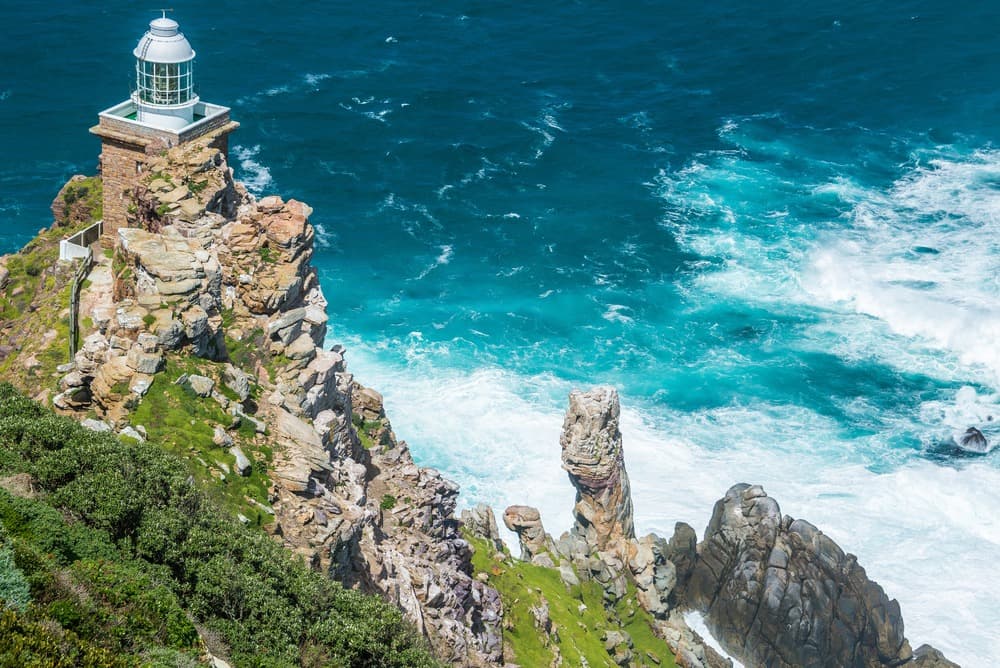
Cape Point
Cape Point
60 km south of Cape Town, Cape Point closes the peninsula with a windswept rocky spur: historic lighthouses, fynbos, endemic fauna and views over False Bay and the Atlantic.
Sixty kilometers south of Cape Town, Cape Point closes the Cape Peninsula with a wind-battered rocky spur. The promontory forms part of Table Mountain National Park and combines sandstone cliffs, fynbos vegetation, endemic wildlife and a maritime history marked by shipwrecks.
Why visit Cape Point
Cape Point sits at the southeastern tip of the Cape Peninsula, in close proximity to Cape of Good Hope. The site combines several attractions within a compact area: two historic lighthouses, viewpoints over False Bay and the Atlantic, a funicular that spares you the climb on foot, and a nature reserve populated with antelope, Cape mountain zebras and baboons.
One misconception deserves immediate clarification: the meeting of the Atlantic Ocean and Indian Ocean does not occur at Cape Point. The convergence zone actually stretches along the entire southern coast, between Cape Point and Cape Agulhas, the southernmost tip of the African continent. Cape Point nonetheless remains a major geographical landmark, where the cold Benguela Current and warm Agulhas Current churn up a sea renowned for its unpredictability.
History and legends
The unstable waters have made the promontory a graveyard of ships. Dozens of wrecks litter the surrounding rocks. The steamship Lusitania (not to be confused with the British vessel torpedoed in 1915) ran aground in 1911 on Bellows Rock, a submerged reef south of Cape Point, one of the site's most emblematic wrecks.
The first lighthouse, erected in the 19th century atop the promontory, illustrates an engineering blunder. Positioned 162 meters higher than the current lighthouse, it was visible from too far away in clear weather, luring sailors dangerously close to shore; in foul weather, low-lying fog obscured it completely. This double failure led to a series of wrecks that necessitated construction of a second lighthouse, lower down, completed in the early 20th century. The two structures lie approximately 700 meters apart.
The funicular serving the summit bears the name Flying Dutchman, in reference to the legend of the Flying Dutchman. According to tradition, this phantom vessel has haunted the waters of the cape ever since it was lost there during a tempest, condemned to wander eternally in the vicinity.
What to see and do
The two lighthouses and the funicular
The Flying Dutchman Funicular connects the parking area to the summit in less than three minutes, with a capacity of 30 passengers per journey. From the upper platform, the panorama encompasses False Bay, the Atlantic and the peninsula's extremity. A flight of steps then leads to the old lighthouse. Walkers can reach the summit on foot via a marked path. The new lighthouse, operational and lower, is reached by a separate ridge trail approximately 700 meters away.
Fauna and flora
The reserve protects a characteristic sample of fynbos, the shrubland vegetation endemic to the Cape, classified as a World Heritage site. On the fauna side, you may encounter:
- antelope: steenbok, eland, bontebok;
- Cape mountain zebra;
- troops of chacma baboons (observe at distance, never feed);
- clawless otters in coastal areas;
- rare amphibians, including the ghost frog.
Cetacean watching
Southern right whales frequent the peninsula's waters between May and November, when they come to calve and mate. Dolphins and seals can be observed year-round with a bit of luck.
Hiking trails
Several marked routes depart from the parking area or nearby beaches (Buffels Bay, Platboom). Allow 1 to 2 hours for short loops around the promontory, longer for coastal trails crossing the reserve.
Practical information
Cape Point is integrated into Table Mountain National Park. Admission is paid at the gate at the reserve entrance. The funicular is paid separately at the foot of the lighthouse. Plan for a half-day to a full day to combine the promontory, Cape of Good Hope and the peninsula's beaches.
- Bring a windproof jacket: the site is exposed and wind often strong.
- Water, hat and closed-toe shoes are recommended.
- Leave no visible objects in vehicles: baboons open poorly closed doors.
- Restaurant and shop are located near the funicular.
When to go
The Cape's climate is Mediterranean, with dry summers (December-February) and mild but rainy winters (June-August). To combine good weather and visibility, the most favorable period extends from October to April. November to January are the busiest months. If whale watching is your priority, favor the May-November window, accepting more variable weather conditions. Strong wind episodes (south-easter) may restrict access to certain trails in summer.
How to get there
No public transport serves Cape Point. Three options are available from Cape Town:
- Rental car: the most flexible option. Allow 1 hour 15 minutes to 1 hour 30 minutes by road via the M3 then M65, passing through Simon's Town. Chapman's Peak scenic drive (toll) makes for a pleasant return journey on the Atlantic side.
- Organized excursion: many agencies in Cape Town offer combined day trips Cape Point – Cape of Good Hope – Boulders Beach (penguins).
- Taxi or private car service: feasible for a round trip, negotiate rate and waiting time in advance.
Nearby
- Cape of Good Hope, a few kilometers to the northwest, usually visited the same day.
- Boulders Beach and its colony of Cape penguins, on the return route toward Simon's Town.
- The Zeitz Museum of Contemporary Art Africa, to explore once back in Cape Town.
- The Cape Parliament, in the historic city center.
Frequently asked questions
Frequently asked questions
No. The convergence zone of the two oceans extends along the entire southern coast, between Cape Point and Cape Agulhas, which is the true southernmost tip of Africa.
The Flying Dutchman Funicular reaches the summit in less than three minutes and proves convenient in strong wind or with children. The walk up takes about twenty minutes via a switchback trail, accessible to anyone in reasonable fitness.
Southern right whales can be observed from May to November. Peak viewing generally occurs between August and October.
Allow 2 to 3 hours to visit the promontory and lighthouses. Combining Cape Point with Cape of Good Hope and Boulders Beach, plan a full day from Cape Town.
No, no public transport serves Cape Point. You must rent a car, book an excursion or take a private taxi from Cape Town.
Include Cape Point in your trip
Cape Point naturally features on any itinerary in the Cape region, complementing Cape of Good Hope and the peninsula's scenic drive. To tailor your stay, consult our journeys in South Africa.
Interested in this visit?
We can include it in your personalised itinerary.