Parliament of Cape Town
Parliament of Cape Town
Seat of South African legislative power in the heart of Cape Town, Parliament tells the story of apartheid and democracy through its architecture and art collection.
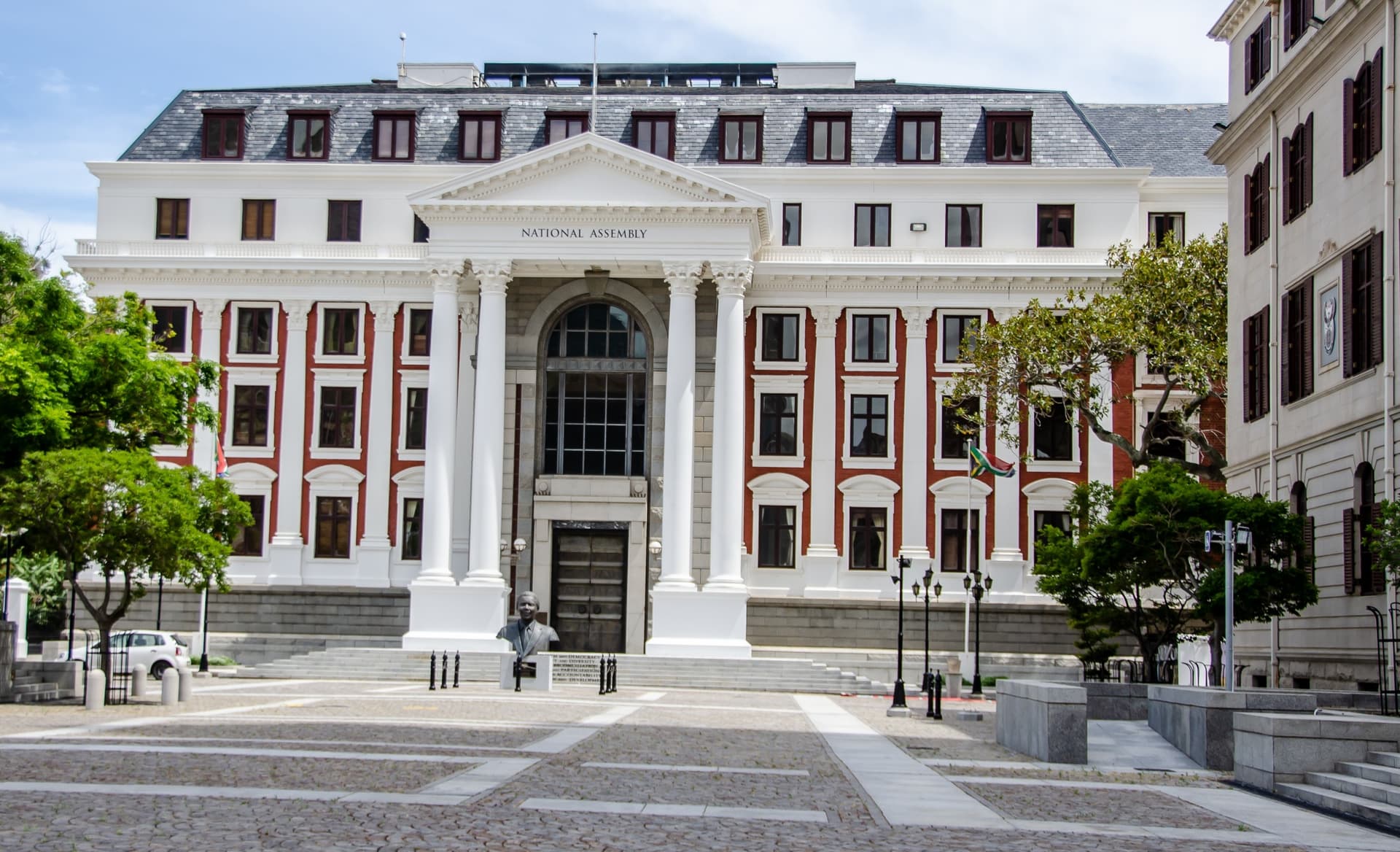
Parliament of Cape Town is the seat of South Africa's legislative power. Located in the heart of Cape Town, a stone's throw from the Company's Garden, this 19th-century building has witnessed the country's major political turning points: the adoption of apartheid laws, their repeal, and the transition to democracy in 1994. A guided tour grants access to an art collection of over 4,000 works and provides concrete insight into contemporary South African history.
Why visit Parliament of Cape Town
- Understand South African political history, from British colony to post-apartheid democracy, in the very place where these decisions were made.
- See Victorian architecture designed by Charles Freeman and the Assembly Chamber conceived by Sir Herbert Baker, whose green leather chairs mirror the British House of Commons.
- View a collection of rare art and documents: original copy of Die Stem van Suid-Afrika, engravings by François Levaillant, satires by Daniël Cornelis Boonzaier, map by Sebastian Münster.
- Witness the aftermath of the January 2022 fire, a significant event that reignited debates on national heritage conservation.
History of Parliament of Cape Town
Parliament of Cape Town was founded in 1853 by Queen Victoria. It served as the legislature for the British Cape Colony and operated with two chambers: the House of Assembly and the Legislative Council. This structure persisted until the creation of the Union of South Africa in 1910, which transformed the institution into a national parliament. The original building, designed by architect Charles Freeman, is recognized by its Corinthian porticos and dome. An extension was added in 1884 to accommodate growing parliamentary activity.
The premises then became the stage for major debates: the Anglo-Boer War, two World Wars, the political shift toward the National Party in 1948, and the implementation of the apartheid regime. Apartheid, an Afrikaans word meaning "separation," was the institutionalized system of racial segregation in place from 1948 until its gradual dismantling in the early 1990s. It was also here that Hendrik Verwoerd, one of the primary architects of this regime, was assassinated in 1966 within the Assembly Chamber.
The year 1990 marked a turning point. Frederik de Klerk, the country's last white president, lifted the ban on the African National Congress (ANC), and Nelson Mandela was released after 27 years of imprisonment. Parliament then repealed the founding laws of apartheid. Equal civil rights for all South Africans materialized in 1994, during the first non-racial national elections and the formation of a constituent assembly.
What to see during the visit
Architecture and parliamentary chambers
The original 19th-century façade remains the complex's most recognizable element. Inside, the Assembly Chamber designed by Sir Herbert Baker echoes Westminster's visual language, with its green leather seats and opposing arrangement. Visitors also traverse spaces added through extensions, which bear witness to the country's institutional evolution.
The art collection
Parliament holds over 4,000 works and historical documents. Among the highlights:
- The original copy of Die Stem van Suid-Afrika, the former national anthem now integrated into the current anthem.
- Writings and plates by François Levaillant, an 18th-century naturalist and explorer.
- Political caricatures by Daniël Cornelis Boonzaier, a leading figure in South African satirical drawing.
- A woodcut map hand-colored by Sebastian Münster.
- The Keiskamma Tapestry, 120 meters long, inspired by the Bayeux Tapestry. It traces the history of the Eastern Cape through to the 1994 elections.
Institutional functioning
The current Parliament is bicameral. The National Assembly, the lower chamber, comprises 400 members elected by universal suffrage. The National Council of Provinces represents the nine provinces and allows regional levels to influence national legislation. The guided tour explains the role of each chamber and voting procedures.
Traces of the 2022 fire
On January 2, 2022, around 5 a.m., a fire broke out in the old section of the building, dating from 1884. The investigation established that the fire started at two separate locations and that the fire suppression system's effectiveness was hampered by a water supply interruption. There were no fatalities, but the damage was severe: the west wing and the lower chamber were heavily impacted, and artworks were destroyed. Restoration work is ongoing and affects the scope of visits.
Practical information
A visit to Parliament is only available as part of guided tours, by prior reservation. Given restoration work following the 2022 fire, the route and access conditions change regularly. It is recommended to verify the details on Parliament's official website before visiting.
- Duration: allow approximately 1 hour for the standard tour.
- Days: weekday tours, excluding public holidays and sensitive parliamentary sessions.
- Identification: passport required to enter the premises.
- Dress code: smart attire required; security checks at the entrance.
- Photography: restrictions apply depending on areas; follow your guide's instructions.
Nearby attractions
Parliament is located within the perimeter of the Company's Garden, a historic garden founded in the 17th century by the Dutch East India Company. On foot, you reach several significant Cape sites within minutes, including the Bo-Kaap neighborhood with its colorful houses, as well as Zeitz MOCAA, a contemporary African art museum located at the V&A Waterfront. For a full-day excursion, the Cape Peninsula and the Franschhoek wine valley complement a Cape Town stay.
How to get there
Parliament is located on Parliament Street, in Cape Town's City Bowl. From most city center hotels and the V&A Waterfront, it's reachable on foot in 15 to 25 minutes. The MyCiTi network serves the area, with several bus stops near the Company's Garden. Taxis and ride-hailing services (Uber, Bolt) remain the simplest option for a quick drop-off. If arriving by car, rely on public parking in the city center; direct parking in front of the building is restricted for security reasons.
Frequently asked questions
Frequently asked questions
No. Access is only available as part of guided tours, by prior reservation. An identification document is required at the entrance.
The building is situated in central Cape Town, within the Company's Garden perimeter, on Parliament Street.
The January 2, 2022 fire damaged the west wing and the lower chamber. The tour route has been adapted according to ongoing restoration work. Details change regularly.
The collection contains over 4,000 works. Among the most remarkable: the original copy of Die Stem van Suid-Afrika, works by François Levaillant, satires by Daniël Cornelis Boonzaier, a map by Sebastian Münster, and the 120-meter-long Keiskamma Tapestry.
Allow approximately 1 hour for the standard guided tour, plus security screening time at the entrance.
Incorporating Parliament into your trip
Parliament of Cape Town easily combines with a half-day of cultural touring in the city center: Company's Garden, South African National Gallery, District Six Museum. To build a complete itinerary across Cape Town, vineyards, the peninsula and national parks, consult our South Africa travel guide.
Interested in this visit?
We can include it in your personalised itinerary.