Cape of Good Hope
Cape of Good Hope
Mythical promontory of the Cape Peninsula, 70 km from Cape Town: Portuguese history, fynbos, penguins and whales in Table Mountain National Park.
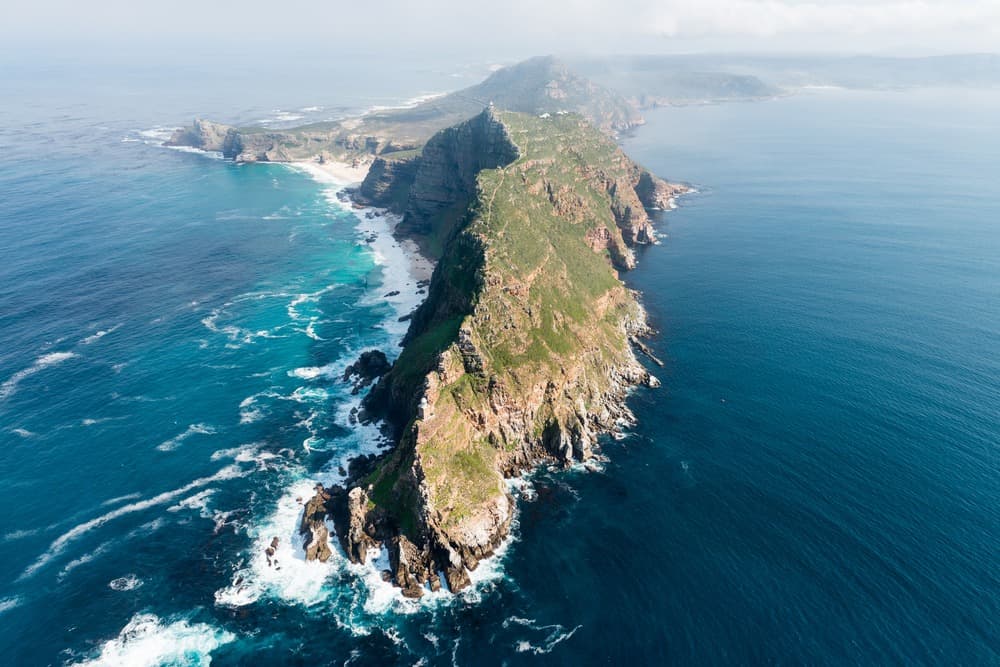
At the southwestern tip of the Cape Peninsula, Cape of Good Hope marks one of the pivotal points in world maritime history. Red cliffs plunging into the Atlantic, wind-swept fynbos, penguin colonies and waters frequented by whales: this promontory, located approximately 70 km from Cape Town's city center, is part of Table Mountain National Park.
Why visit Cape of Good Hope
The site combines three rarely-united interests. First and foremost, it is a major navigation landmark, associated with Portuguese explorers Bartolomeu Dias and Vasco da Gama, whose routes to the Indies passed by this promontory. It is also a natural sanctuary: the peninsula belongs to the Cape Floral Region, one of six great floral kingdoms on the planet, and harbors dense marine and terrestrial wildlife. Finally, it is a vantage point where the ocean, cliffs and fynbos compose a landscape unparalleled in the region.
Contrary to popular belief, Cape of Good Hope is not the southernmost point of Africa: that distinction belongs to Cape Agulhas, located roughly 150 km further east. Cape of Good Hope remains nonetheless the symbolic landmark of the passage between the Atlantic and Indian oceans.
History of the Cape
Portuguese explorer Bartolomeu Dias landed on the cape for the first time on March 12, 1488. Confronted with violent winds and unpredictable currents, he named it Cabo Tormentoso, the "Cape of Storms". The crown was unimpressed by the name: King John II of Portugal changed it to Cape of Good Hope, in reference to the new maritime route opening toward Asia. A few years later, Vasco da Gama used this route to reach the Indies, cementing the commercial importance of the passage.
To signal the site to navigators, colonists built the crosses of Dias and da Gama, which served as landmarks for sailors sailing along the coast. In terms of protection, the Cape of Good Hope peninsula was sanctuarized in 1938, then attached in 1998 to the Cape Peninsula National Park, now Table Mountain National Park.
What to see and do
Viewpoints and trails
The cape itself is reached via a short trail from the parking area. Hikers often extend to Cape Point, located nearby, whose lighthouse offers panoramic views of the ocean. Several marked routes traverse the reserve, from coastal trails to longer loops through the fynbos.
Wildlife
Marine wildlife ranks among the main attractions: seals, dolphins, sea lions, sea otters and African penguins frequent the waters and shores of the peninsula. Several cetacean species are observable offshore, notably the southern right whale, humpback whale and Bryde's whale.
On land, the park shelters herbivores familiar to the region: deer, elk, springbok and zebras. Visitors also encounter chacma baboons, of which one should be wary (never leave food within reach). Approximately 250 bird species are recorded in the park, from wild ostriches to endemic songbirds.
Flora
Fynbos, the bushy vegetation characteristic of South Africa's southwest, dominates the landscape. It includes emblematic species of the Cape Floral Region: proteas, ericas and honey pots, some of which grow nowhere else in the world.
Practical information
- Status: southern section of Table Mountain National Park, paid entry (moderate fee, payment at the gate).
- Duration of visit: allow a half-day for the cape and Cape Point, a full day if you combine with other peninsula sites.
- Equipment: bring a windbreaker, hiking shoes and water; wind can be violent even in fair weather.
- Safety: do not feed the baboons, keep car windows closed in parking areas.
When to go
The climate of the Cape region is Mediterranean, with cool, rainy winters (May to August) and dry, windy summers (November to March). To visit the cape in good conditions, austral summer (October to April) offers long days and generally clear skies, ideal for panoramas and hiking. The southeast wind, called the "Cape Doctor", can nonetheless blow strongly in summer.
For whale watching, the window extends from June to November, peaking between August and October. Austral spring (September-October) is also the best season for fynbos blooms.
How to get there
Cape of Good Hope is located approximately 70 km south of Cape Town's city center. The most common route is by car, using the scenic Chapman's Peak Drive, which winds along the western coast of the peninsula between Hout Bay and Noordhoek. This toll road offers sweeping views over the Atlantic.
Travel time depends on traffic and photo stops: allow plenty of time. Several agencies offer guided day excursions from Cape Town, often combined with the penguin colony at Boulders Beach. The hop-on hop-off tourist bus also serves the peninsula in season.
Combining sites in the peninsula
The cape is rarely visited alone. Along the coast, several sites merit a stop:
- Clifton and Camps Bay: popular beaches near Cape Town.
- Long Beach and Noordhoek: long stretches of sand, recognized surf spot.
- Kommetjie: quiet seaside resort with a white lighthouse.
- Cape Point: neighboring promontory with historic lighthouse and funicular.
- Boulders Beach: African penguin colony, at Simon's Town.
For a comprehensive overview, consult our guide to the Cape Peninsula.
Frequently asked questions
Frequently asked questions
No. The southernmost point of the continent is Cape Agulhas, located roughly 150 km to the east. Cape of Good Hope remains nonetheless the symbolic landmark between the Atlantic and Indian oceans.
Allow a half-day for the cape and Cape Point from Cape Town. A full day permits you to include Chapman's Peak Drive, Boulders Beach and several peninsula beaches.
Yes, between June and November. Three species are regularly observed: the southern right whale, humpback whale and Bryde's whale. Hermanus, further east, remains the region's best viewing spot.
Yes. A moderate entry fee is collected at the gate of Table Mountain National Park (Cape of Good Hope section). Holders of the South African Wild Card benefit from included access.
Yes. The chacma baboons of the peninsula are accustomed to humans and can open bags and cars. Keep windows closed, leave no food visible and do not attempt to approach them.
Planning your trip
Cape of Good Hope naturally fits into an itinerary combining Cape Town, the wine route and the wildlife parks of the northeast. Discover our suggestions for trips to South Africa to build a custom stay.
Interested in this visit?
We can include it in your personalised itinerary.